

Driving in New Zealand and Australia Tips for First Timers: What Your Rental Contract Won’t Tell You

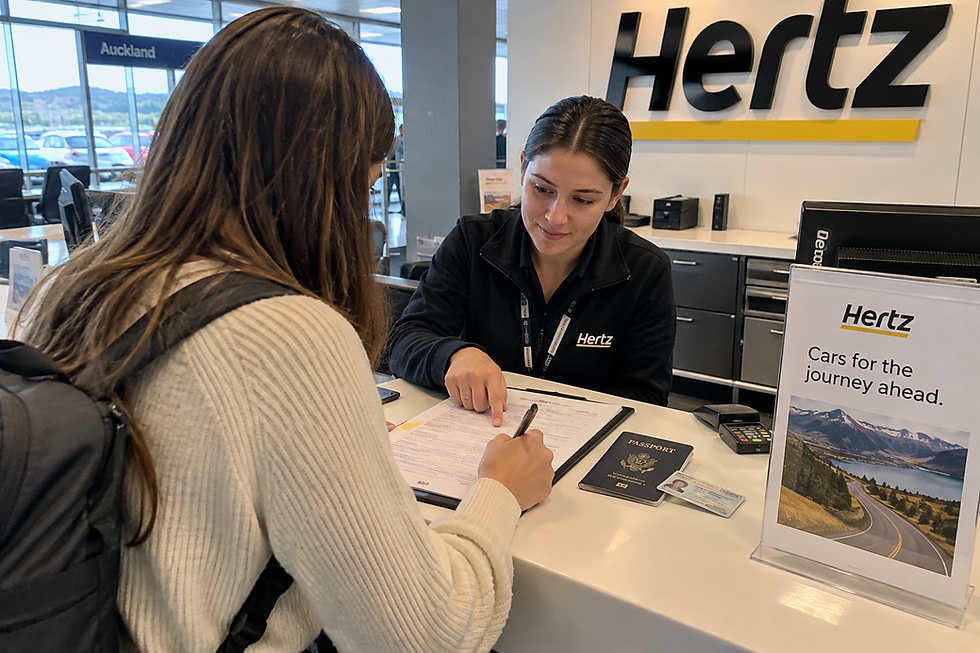
The most expensive four seconds of your trip will happen under fluorescent lights, with a pen in your hand and a line of tired travelers shuffling behind you. You have just stepped off a fourteen hour flight. The agent slides a rental contract across the counter and you initial page after page without reading a single word. I have watched that moment play out at airport counters from Christchurch to Alice Springs. It is the reason the most useful driving tips in New Zealand have very little to do with which side of the road you drive on.
Driving on the left becomes second nature faster than most first timers expect. What catches people is everything surrounding it: The clause that can quietly void your cover once the sun goes down. The gravel lane to a farm stay your agreement never allowed. A bridge built for one car at a time. The drowsiness that settles in an hour after you felt perfectly fine.
Picture two drives. In the first, you are crossing the South Island high country with the window cracked, glacier air sharp enough to taste, and sheep scattering from the verge as you round another bend. In the second, you are deep in the Australian Outback with red dust hanging in the mirror and a road train growing larger behind you, the next town still hours away.
Both drives are extraordinary, and both ask very different things of you. What follows is what each one asks, the fine print nobody explains, and how I plan trips so the road stays the best part of the story rather than the most stressful.
Driving in New Zealand and Australia Tips for First Timers: What Your Rental Contract Won’t Tell You
Before You Turn the Key: Licenses, Paperwork, and the Right Answer
Paperwork is the least romantic part of any road trip. Yet somehow, it is also where travelers lose the most sleep. The reason is simple: The internet disagrees with itself, and it does so confidently.
Can I Drive in New Zealand With a US License?
Picture yourself at eleven at night, three weeks before departure, with four browser tabs open and four different answers staring back. One says twelve months. One says you absolutely need an international permit. One says you do not. One is trying to sell you something.
Here is the answer from the source that matters. New Zealand's official tourism site states that visitors can legally drive for up to 18 months on a current driver's license. It also states that a license not written in English must travel with an accurate English translation.
The twelve month figure you keep seeing belongs to a different route: Drivers relying on an International Driving Permit can use it for up to 12 months, provided they also carry the home license it is based on.
So for a full, current US license, you are covered for any realistic holiday. Two small details trip people up. A learner's permit does not count as a valid overseas license. Plus, the physical card needs to be in your wallet every time you drive. Not sitting in the safe back at the lodge.
Driving in Australia as an American: What to Carry
Australia adds a twist, because each state and territory writes its own rules. The good news is that they agree on the essentials.
The national road agencies explain that temporary visitors can generally drive on a valid overseas license. There are time limits of 3 months in the Northern Territory and 6 months in New South Wales and Victoria. Other states allow driving for as long as the license stays current. Visitors must carry that license at all times, adding a permit or English translation only when it is not written in English.
Your US license already clears the language bar. I still suggest an International Driving Permit for anyone crossing several states, because Canberra's licensing authority says visiting drivers should carry one. A rental desk that asks for it will not care what another state allows. It has to come from the same country that issued your license, so arrange it before you fly.
One more quiet rule applies in both countries: You can only drive the vehicle classes your home license covers. If a large motorhome is part of the dream, check its weight against your license first.
Driving on the Left Side of the Road Tips That Work Better Than a Sticky Note
Switching sides is less about skill and more about outsmarting a habit your body has practiced for decades. These are the habits I teach every first timer, in the order they tend to matter.

The Center Line Rule
You pull out of the airport parking lot, signal for your first turn, and the wipers sweep across a perfectly dry windshield. Everyone does it. On most right hand drive cars the indicator and wiper control levers swap sides, while the pedals stay exactly where your feet expect them.
The rule that fixes almost everything else comes straight from Tourism Australia: The driver should always sit closest to the center of the road. If you glance right and see the painted center line beside your shoulder, you are where you belong. If you see the curb, something has gone wrong. Of all the driving in New Zealand tips I pass along, this one is best, because it works identically on an Australian highway.
Before you leave the parking lot, give yourself five unhurried minutes. Set the mirrors. Find the headlights and hazard lights. Practice the indicator until your hand stops reaching for the wrong control lever.
The Empty Road Trap
City traffic keeps you honest, because there is always a car ahead showing you the way. The risky moment is quieter. You have stopped for a flat white or a photo of a lake. You pull back onto an empty country road with nobody to follow. That is when decades of muscle memory tug the wheel toward the right side.
Make a small ritual of every restart: Say "stay left" out loud as you pull away. It feels silly for a day and then it saves you. Remember too that right turns are now the long sweep across oncoming traffic. Left turns are the tight ones. Oh, and roundabouts flow clockwise with priority given to vehicles coming from your right.
The Passenger Seat Is a Real Job
The best road trips I plan treat the person in the passenger seat as a copilot, not a spectator. The driver drives. The navigator handles the map, reads signs early, and calls out upcoming turns. They also keep an eye on the left edge of the road on narrow stretches. After all, this is where a new driver's sense of the car's width is still catching up.
It changes the whole mood inside the car. Instead of one tense person gripping the wheel and one anxious person gripping the door handle, you become a team working a new road together. By the third morning, you will notice you have stopped talking about which side you are on, and started talking about the view.
Driving in New Zealand Tips for the Roads Themselves
The roads that make New Zealand so rewarding are the same ones that ask the most of visitors.

Driving in New Zealand Tips for One Lane Bridges
Rain is drifting sideways off the Tasman Sea. Ahead of you, a long, narrow bridge stretches across a braided gray river. Its railings are beaded with water. On the far bank, a campervan has slowed too, and for one long second you both hesitate. This is the moment a sign is meant to settle.
Reading the Arrows
Every one lane bridge is marked on the approach. On the sign, the big black arrow shows which direction has priority. If your side of the sign shows the small red arrow, you give way and wait for oncoming traffic to clear.
Priority does not mean charging ahead. If someone is already on the bridge, let them finish, even when the arrow favors you. When you truly cannot tell who should go, waiting is always the safer choice and nobody will mind.
You will see these bridges most often on the quieter rural roads of the South Island. Although, a few sit on busy coastal routes such as the Coromandel coast road.
The Moment After the Bridge
The bridge itself is rarely where things go wrong. It is the exit. For those few seconds you were driving down the middle of a single lane, and your brain can easily forget which side to return to. Local driving guidance warns visitors about exactly this. Longtime visitors report meeting cars on the wrong side of the road most often just past a one lane bridge.
So make the exit deliberate: Eyes on the left lane before your wheels leave the deck. And if another driver waited for you, lift a hand from the wheel. That small wave is one of the first ways you become part of the rhythm of a place, rather than a visitor passing through it.
New Zealand Gravel Roads, Rental Car Rules, and Switchbacks
Some of the country's loveliest corners, a high country sheep station, a remote trailhead, a lakeside farm stay, sit at the end of an unsealed road. Knowing how to drive one, and whether you are allowed to, are two very different questions.
How Gravel Feels Under a Rental
The first thing you notice is the sound. A steady crunch under the tires like walking on a vineyard path after harvest. The second is the float. A slight looseness in the steering that tells you the car has less grip than it had a minute ago.
Slow right down, keep a firm hold of the wheel, and give yourself far more stopping distance than feels necessary. Experienced visitors suggest 50 to 60 km/h is more realistic than the posted limit.
Sudden braking is the enemy here, because loose stones can send the car into a skid. On switchbacks, brake before the bend while the wheels are straight, then roll through the curve gently. Keep well left on narrow stretches, and ease off when a car approaches, since flying stones crack windshields and dust can swallow the road ahead.
If a road starts to feel wrong, turn around. Nobody's itinerary is worth pushing on.
The Roads Your Contract Names
Skippers Road near Queenstown winds into a gold rush canyon. It is mostly one lane wide, steep and narrow, with drops of several hundred meters beside the wheels. It is also the most famous road in the country where rental insurance simply does not apply. It is not alone. Typical agreements rule out Ball Hut Road near Aoraki Mount Cook, Ninety Mile Beach, the Te Paki stream bed, and the old road to Macetown.
Here is the part rarely explained in plain words. Damage on an excluded road can leave you paying the full repair cost, whatever damage waiver you bought. Among the driving tips in New Zealand that save real heartache, this is near the top: Read the excluded roads list before you collect the keys. When a client longs to see Skippers Canyon, I arrange a guided trip with a local driver who knows every corner. This way, the canyon becomes the highlight instead of the risk.
Why Your GPS Underestimates Every Drive
Your phone says three hours. You arrive after four and a half, tired, a little frazzled, and too late for the walk you planned. I suggest adding a 30 to 40 percent buffer to online time estimates. After all, mountain passes, lake edges, and one lane bridges rarely let you hold the open road limit for long.
Part of the difference is courtesy. On a climbing road like the Haast Pass, a line of cars may form behind you. Look for passing lanes, where slower traffic keeps left, and for small pull over bays where you can let the queue go by. Do it, wave them past, and then enjoy the pass at the speed it deserves.
Outback Driving Safety Tips for Australia's Long Roads
Cross the Tasman and the challenge flips. New Zealand keeps your hands busy with curves and bridges, while the Outback tests patience and endurance on roads that run straight to the horizon. The best driving tips in Australia start with a humbling truth from travelers who know the interior well: The vast majority of the small number of tourist deaths in Australia come from road accidents, not heat or snakes.

Distance, Fuel, and Signs That Mean Exactly What They Say
The fuel gauge sits at half. Outside, saltbush and red earth run flat in every direction, and the heat shimmer turns the road ahead into water. Somewhere up there is the next roadhouse, and you are fairly sure you remember how far.
Fairly sure is not good enough out here. On major Queensland highways, fuel stops are rarely more than 200 kilometers apart. However, a sign warning of no fuel means exactly that.
My rule is simple: Never pass a pump with less than half a tank. Calculate distances between stops before each day begins. Keep an alternative route in mind during the November to April storm season. Download offline maps, since mobile coverage disappears for long stretches. In an emergency, dial 000, and consider the Triple Zero app, which can share your GPS position with emergency services.
Sharing the Road With Road Trains
First it is a speck in the mirror. Then a shape. Then a wall of chrome and dust pulling three or four trailers, stretching past 50 meters from grille to tail. Road trains are the lifeblood of remote Australia. Sharing the highway with them calmly is a skill worth learning early.
When one approaches from either direction, slow down and move as far left as safely possible. On a narrow road, the kinder choice is to pull fully off the bitumen, rather than forcing the truck onto the gravel where it will shower you with stones. Expect a jolt from its slipstream and a moment of blinding dust as it passes.
Overtaking one takes a long, straight, completely clear stretch of road. If you have any doubt at all, simply stay behind and enjoy the scenery a little longer.
Dusk, Dawn, and the Animals That Own Those Hours
The light is the most beautiful at the edges of the day, when the red earth glows and the sky turns apricot. It is also when kangaroos, emus, and wombats are most active, and when their shapes blur into the scrub. Add wandering cattle and roughly a million free roaming camels, and you understand why seasoned Outback travelers plan to arrive before sunset.
Read the country as you drive. In dry seasons, kangaroos gather along road edges to graze the thin green strip that runoff leaves behind. Fresh roadkill with wedge tailed eagles feeding beside it tells you the area is busy.
If the low sun is blinding you, I suggest pulling over for half an hour and letting it rise or set. Preferably, watch the sunset from your veranda, not from behind the wheel.
What to Do If You Hit a Kangaroo
Kangaroos change direction without warning. If a collision cannot be avoided, brake firmly in a straight line rather than swerving, since veering into oncoming traffic or losing control is far more dangerous than the impact itself. Afterward, pull off the road where it is safe and switch on your hazard lights.
Approach the animal only when it is safe to do so, and never on a high speed road with traffic passing. If it is alive, leave it where it is and contact local wildlife rescue or emergency services. Females often carry a joey in the pouch, which rescuers can sometimes save, so mention it when you call. Then check the car and report the incident to your rental company.
Caring for the wildlife that shares these roads is part of traveling here.
Can I Take a Rental Car on Unsealed Roads in Australia?
Usually not, unless you have permission in writing. Australian rental agreements generally keep cars on sealed roads by default, with one common exception: A short, well maintained access road leading to a recognized campground, accommodation, or major attraction. How far that exception stretches varies widely between companies. It can be from a few hundred meters to several kilometers.
A four wheel drive does not automatically open the door either. Off road routes typically require a true four wheel drive with low range gearing plus written approval. Some remote routes stay off-limits even then.
In Western Australia, beaches, sand, salt flats, and tidal areas are generally excluded. A park permit or a four wheel drive badge will not override the rental agreement.
Legendary routes like the Gibb River Road call for a proper off road vehicle, which is exactly the kind of detail I plan long before you land.
What Your Rental Contract Won't Tell You
The earlier sections covered which roads are off limits. This is about the clauses that follow you everywhere, sealed road or not. They are the ones nobody mentions while you are initialing page twelve.
The Dusk Clause
Imagine a perfect Outback afternoon. You linger at a gorge longer than planned because the light on the rock walls is turning copper. You then drive the last stretch to your lodge as the sky fades to violet. It feels like the best hour of the trip.
On some Australian agreements, it may also be the hour your insurance stopped applying, because driving between dusk and dawn on roads outside cities can void cover.
The same fine print can restrict taking the car on a ferry or crossing state borders. Some companies even ask first time visitors to complete a road rules quiz or a short supervised drive before handing over the keys.
None of this is unreasonable. It simply needs to be known before the itinerary is built, not discovered afterward.
Stone Chips, Tires, and Windshields
A road train passes on a gravel shoulder. There is a sharp tick against the glass, and by the next fuel stop a small star has bloomed in the corner of the windshield. It is one of the most common bits of damage on a road trip, and one of the most commonly excluded.
Many agreements treat tire and windshield damage separately. Even the top insurance package may leave them out unless the contract says otherwise.
Do not assume your travel insurance fills the gap. Its rental excess cover often excludes unsealed roads and anything that breaches the rental terms. It may reimburse only the excess itself rather than the extra administration costs a rental company adds.
Five Questions to Ask Before You Drive Away
The calmest travelers I know treat the rental counter as a conversation, not a signature line. They slide their route across the desk and ask:
Is every road on this route permitted for this vehicle?
How far may I drive on an unsealed access road to reach my accommodation?
Are there restrictions on driving at dawn, dusk, or night?
Can this car travel on a ferry or across state borders?
Which damage is excluded from my cover, including tires, glass, and the underside of the car?
Then they ask for anything important in writing. When I plan a trip, these answers are gathered before you ever reach the counter, so the only thing left to do there is smile, sign, and go.
The Hazard That Doesn't Look Like One: Fatigue
Nobody feels dangerous when they are tired. That is exactly the problem. Australia's national road safety strategy notes that fatigue is involved in 20 percent of fatal crashes in Victoria. Queensland researchers link sleepiness to 20 to 30 percent of deaths and severe injuries. Basically, fatigue is four times more likely to contribute to impairment than drugs or alcohol.
Driving After a Long Haul Flight
You land at six in the morning after thirteen hours in the air. The arrivals hall is bright, coffee is flowing, and you feel oddly wired, ready to go. So you collect the car, merge onto the motorway, and for forty minutes everything is fine. Then the road starts to hum, your eyelids grow heavy, and you realize you cannot remember the last few kilometers.
That is jet lag at work, and it arrives disguised as alertness. Victoria's transport accident agency found that drivers running on less than five hours of sleep are four times more likely to crash, and very few people sleep five real hours on a long haul flight.
So, I design arrival days differently. Your first night is in the city or near the airport. The first day is spent on foot, perhaps along a harbor walk with salt air and a long lunch. The car portion of your trip arrives on day two or three.
If you remember only one of my driving tips in New Zealand, let it be this: The car can wait a day, and your trip will be better for it.
Building a New Zealand Self Drive Holiday Around Shorter Days
The itineraries that feel most generous are rarely the ones that cover the most ground. I usually suggest keeping driving to about three hours a day in New Zealand. This sounds modest until you see what fills the rest of those hours.
A three hour day leaves room for the stops that become the trip. A morning walk between rows of pinot noir vines in Central Otago, gravel crunching underfoot and frost still on the grass. A lakeside pie from a small town bakery. A farm gate stall selling honey and cherries, with an honesty box and a hand painted sign.
I also favor fewer bases with longer stays, so you unpack once and explore in loops rather than living out of a suitcase. When a day does run long, swap drivers every couple of hours, because a fresh pair of hands on the wheel changes everything.
An Australia Self Drive Itinerary That Respects the Distance
Outback roads can run dead straight for so long that the landscape begins to lull you. Long sealed stretches invite drowsiness more than rough dirt roads ever do. The standard advice is to stop every two hours or 200 kilometers. I treat this as a firm part of the itineraries I create rather than a suggestion.
Those stops become the texture of the journey. A roadhouse counter where the owner tells you which waterhole is running this season. A volunteer Driver Reviver stop during holiday periods, pouring free coffee for tired travelers. A stretch of the legs beneath a coolibah tree while cicadas hum. After all, the best cure for tiredness is simple: Pull up, have a cuppa, and walk about.
I plan overnight towns in advance so nobody feels pressured to push through twelve hours. I also build in rest days where the car does not move at all.
Farm Roads, Stock Crossings, and Station Country
Some of the richest experiences in both countries happen on working land: A night on a sheep station. A morning helping with the milking. Dinner at a long table with the family who farms the valley. Getting there means learning a gentler kind of road etiquette, one most guides skip entirely.

When the Road Fills With Sheep
You round a bend on a South Island back road and the tarmac ahead has turned into a moving river of wool. Hundreds of sheep pour toward you bleating and bumping. The smell of lanolin and damp fleece drifting through the vents. Behind them, two dogs work the edges with quiet precision, and a farmer on a quad bike lifts one hand in greeting.
This is not a hazard to push through. Stop, stay put, and let the mob flow around the car. Keep the horn silent and your foot off the accelerator, since a nervous flock scatters in every direction. When the farmer waves you on, roll forward at walking pace.
On the farm itself, the old country rule applies: Leave every gate exactly as you found it. It rarely appears in lists of driving in New Zealand tips, yet travelers tell me it is the moment they remember longest. The day the road belonged to someone else's livelihood and they were simply invited to wait.
Cattle Grids and Station Tracks in the Outback
On an Australian cattle station, the homestead may sit a long way down a red dirt track from the highway. Before you book, confirm that the station's access road falls within your rental's allowance, and get that confirmation in writing. I check this for every station stay I arrange, because a dream night under the stars should never begin with a contract breach.
Along the way you will rattle over cattle grids, steel rails set across the track to keep stock from wandering. Cross them straight and steady, never braking on the rails.
Much of the Outback is unfenced, so cattle may stand on the road itself. Station hands sometimes drive an entire mob across a highway. Pull over, switch off, and watch the dust rise gold around them.
Later, sitting by a fire with the station owners as the stars come out in their thousands, the long drive in starts to make sense. Out here, slowing down is not a delay. It is the whole lesson.
Driving in New Zealand vs Australia: What Changes Across the Tasman
Both countries drive on the left, and that is where the similarities start to thin. The main difference between driving in New Zealand and driving in Australia is the kind of attention each demands: New Zealand asks for constant, careful adjustments, while Australia asks for sustained focus over enormous distances.

Where Each Country Asks the Most of You
In New Zealand, the drive is a conversation. Every few minutes the road asks you something new: A hairpin, a narrowing lane, a bridge, or a tour bus rounding the corner. The driving in New Zealand tips in this guide teach precision. In Australia, the road rarely asks anything at all, and that silence is its own test. The Outback teaches stamina.
For travelers combining both, I usually place the gentler legs first, so confidence on the left is settled before the mountain passes or the long red highways arrive. The order of a trip matters as much as the roads within it.
Checking the Road Before You Go
Weather reshapes these roads faster than any printed map can keep up. A few minutes with the right official source each morning is the simplest safety habit of all.
DriveSafe NZ and New Zealand Road Closures
At one time, a bridge collapse south of Franz Josef cut off the full length of the West Coast for weeks. Most closures are far smaller. A slip after heavy rain or snow on a pass. However, any of them can turn a planned day upside down.
Before you arrive, spend twenty minutes with DriveSafe NZ. This is the official resource built for visiting drivers. It offers plain, easy to follow advice on local road rules and etiquette.
Once you are traveling, check the national transport agency's live road closure map each morning before you set off. If a road is closed, the i-SITE visitor center in the nearest town can suggest the best alternative. Often with a few local stops worth adding along the way.
Australia Road Conditions by State
Australia has no single road report, because each state runs its own. Live Traffic NSW, QLDTraffic, VicTraffic, the Northern Territory Road Report, and the Main Roads Western Australia travel map each cover their own territory. It is worth bookmarking every one your route crosses.
Whatever the state, check conditions each morning and again before any unsealed or remote stretch, since a single storm can close a road for days.
Frequently Asked Questions
Should I rent an automatic car?
Yes, if you are not used to driving on the left. I recommend an automatic for exactly this reason, since it leaves you one less thing to learn. In a manual car you would be changing gears with your left hand while also rewiring every other instinct.
Can I use my phone for navigation while driving?
Only hands free. Holding a phone while driving is illegal in both countries, so mount it securely and set your destination before the car moves. From there, let voice directions do the talking while your eyes stay on the road.
What are the drink driving limits?
In New Zealand, drivers under 20 must not drink at all. Drivers 20 and over are limited to 50 milligrams of alcohol per 100 milliliters of blood. Roadside checkpoints are common, and every driver is stopped and tested.
In Australia, full license holders are limited to a 0.05 blood alcohol level. For a day among the cellar doors of Marlborough or the Barossa, I arrange a guided tasting so the only thing you steer is your glass.
Is it safe to drive in New Zealand in winter?
It can be, with preparation and the understanding you may need to change plans. The Milford Road is the clearest example. From May to October, snow, ice, and avalanche risk shape every journey. The transport agency recommends every driver carry chains, and police can fine drivers who pass signs requiring them.
There is no fuel between Te Anau and Milford Sound. Drivers without winter experience are encouraged to take a coach from Te Anau instead.
Winter is also when the kea, the cheeky alpine parrot, comes closest to cars. Please do not feed them. Among the driving tips in New Zealand I give for the colder months, the most important is to leave later in the morning, once the sun has reached the shaded bends.
What should I do if I break down somewhere remote?
Stay with your vehicle. A car is far easier for rescuers to find than a person walking. Plus, it offers shade from the sun. Before any remote stretch, pack plenty of water, a first aid kit, a flashlight with spare batteries, and a high visibility vest. Oh, and make sure the spare tire is inflated and the jack is where the rental company says it is.
What if I am too nervous to drive at all?
Then you do not have to. Some of my favorite trips are hybrids: You drive the easy, rolling stretches through farmland and wine country, and let local experts handle the demanding ones. A coach to Milford Sound, a small group day into the Outback, and a scenic flight over the Southern Alps. You still get the freedom of your own car, without spending a single white knuckled hour behind the wheel.
The Morning It All Clicks
There is a morning, usually around day three, when you pull out of a lodge driveway and realize you never once thought about which side to take. Mist is lifting off the lake, the car smells faintly of the coffee you bought in town, and two paddocks over a farmer is easing cattle toward the yards. You are no longer managing a road. You are simply moving through a place that has started to feel familiar.
That morning is what all of these driving in New Zealand tips, and their Australian cousins, exist to protect. The contract questions, the arrows, the fuel stops, the rested arrival day: They are there so your attention can go where it belongs. To the land, the people who work it, and the version of yourself that surfaces when life finally slows to the pace of a country road.
If a morning spent among vines, or an afternoon on a working farm, sounds like your kind of adventure, I would love to help you find it. You do not have to plan a single detail of this. That is what I am here for. Reach out whenever the timing feels right.
Signing up for my newsletter is the best way to ensure you receive more tips like this, so you are always ready for whatever is waiting for you during your vacation.


