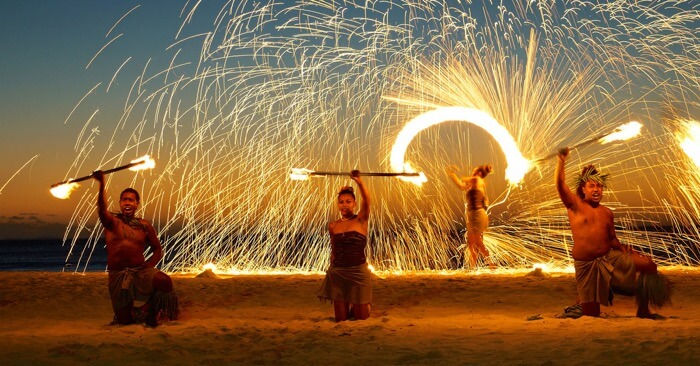
The Festival Most Tahiti Travelers Have Never Heard of Is the Reason to Go in July: Heiva i Tahiti 2026: Drums, Fire, Dance, and the Most Extraordinary Cultural Festival in the South Pacific
Most people who book a trip to French Polynesia spend months obsessing over overwater bungalows and never once hear the name Heiva i Tahiti 2026. This means they are unknowingly planning to miss the single most extraordinary thing the islands have to offer. The drums start before you see the stage. You feel them first, low and insistent, somewhere behind your sternum. It is as if the island itself has a pulse and you have finally gotten close enough to hear it. That is the moment when Tahiti stops being a destination and becomes an experience you will spend the rest of your life trying to explain to people who were not there.
This is not a festival that exists for tourists. It is not a cultural showcase packaged for easy consumption. Heiva i Tahiti is the living, breathing, fiercely protected heartbeat of Polynesian identity. And in July 2026, the islands will assemble once again in a way they have been assembling, in one form or another, since 1881.
If you are going to go to Tahiti, go in July. Go for this.
The Festival Most Tahiti Travelers Have Never Heard of Is the Reason to Go in July: Heiva i Tahiti 2026: Drums, Fire, Dance, and the Most Extraordinary Cultural Festival in the South Pacific
What Is Heiva i Tahiti and Why Does It Matter?
The word "Heiva" translates from Tahitian as "to assemble." It is a quietly powerful word for something that carries enormous weight. Every July, communities from across the archipelagos of French Polynesia converge on Papeete to present their arts, their ancient athletic traditions, their music, their dance, and the accumulated wisdom of generations who kept these things alive even when powerful outside forces worked hard to extinguish them.

Heiva i Tahiti 2026 marks another year of that convergence. And it belongs on the calendar of every traveler who takes the South Pacific seriously. If you have been asking yourself what Heiva i Tahiti is and should I go, let me answer the second part of that question right now: Yes, without hesitation.
Why This Festival Stands Apart from Many Others
South Pacific cultural travel offers no shortage of beautiful experiences. Sunsets over volcanic peaks. Lagoons so blue they look invented. Hospitality that makes you feel like you have been expected.
But Heiva i Tahiti operates at a different register entirely. What happens at To'ata Amphitheater each July is not a demonstration of culture arranged for outside eyes. It is a fiercely contested competition among cultural custodians who have spent months, sometimes the better part of a year, preparing for a few nights on that stage.
The stakes are real. The pride of the locals runs deep. And the emotion that moves through the amphitheater on a competition night is the kind that makes strangers quietly reach for each other's arms.
Every community that gathers here arrives with something to prove. Not to the audience, but to their ancestors and to themselves. For a traveler willing to sit inside that truth and receive it, there is nothing else in the Pacific that comes close.
Heiva i Tahiti 2026: Dates, Location, and How the Festival Unfolds
Heiva i Tahiti 2026 runs from July 2 through July 18 at the To'ata Amphitheater on Boulevard Pomare IV in Papeete. The To'ata sits at the edge of the waterfront, open to the harbor air, with the kind of natural theatrical setting that no architect could have improved upon.
This Tahiti cultural festival in July 2026 is not a single-venue, single-event affair. It is located across Papeete and beyond. It combines traditional sports, canoe racing, sacred ceremony, crafts, and community celebration into the full fabric of the month.
The Nu'uroa Fest, held in the gardens of the Musee de Tahiti et des Iles, extends the festival spirit all the way into August for travelers who can stay long enough to catch it.
What that means practically is that there is no such thing as a wasted day during Heiva week. Something worth witnessing is always happening somewhere.
The Heart of the Festival: The Tahitian Traditional Dance Competition
If the Heiva Festival Tahiti has a soul, it lives inside the dance competition. The Tahitian traditional dance competition is the centerpiece around which everything else orbits. It is the reason the To'ata fills night after night with locals who arrive early, claim their seats, and watch with the focused, reverent intensity of people who understand exactly what is being said on that stage.
Ori Tahiti Dance Performance: Ancient Language in Motion

Ori Tahiti is not a style of dance. It is a language with a full vocabulary and centuries of accumulated meaning. Each movement of the hip, each position of the hand, each tilt of the head communicates something specific, something that has been passed down through generations of oral tradition in the absence of written text.
An Ori Tahiti dance performance tells a story about a legend, a god, a historical event, the sea, the land, or the daily life of a people rooted in one of the most remote and magnificent places on earth. Nothing you see on that stage is decorative. Every single element is chosen.
The costumes alone represent months of labor. Headdresses of feathers, shells, and intricately woven fiber rise to heights that seem to defy gravity. Wraparound skirts of natural materials catch the light and move in counterpoint to the relentless, powerful rhythm of the hips beneath them. The overall visual effect lands somewhere between overwhelming and transcendent.
Then there is the percussion. The pahu, a large double-ended drum carved from a hollow log, generates a sound you do not so much hear as absorb. Low and resonant, it is felt through the soles of your feet and deep in the chest. The to'ere, the smaller slit drum, lays down the rapid staccato patterns that push the dancers toward their peak.
A full competition percussion section performing at full intensity is one of the most genuinely thrilling sounds available to the human ear on a warm night under open sky.
What to Watch for as a First-Time Attendee
Every competing troupe has built their performance around a specific theme. Those themes are often drawn from a legend, historical moment, or tradition particular to their home island or archipelago.
Watch for the passages when the entire troupe moves as one organism. That is when hundreds of bodies answer the same drum pulse with the same perfectly matched movement.
Watch the featured soloists. They are usually young women and men who have been training toward this specific moment for years.
Watch the people around you in the audience. The elders who lean forward and close their eyes. The teenagers mouthing the words of the chants. The small children who have somehow already absorbed all of this into their bones. The audience is part of the performance. Understanding that transforms everything you are watching.
Fire, Stone, and Water: The Events That Will Stop You Cold
The Fire Walking Tahiti Ceremony at Mahana Park
The fire walking Tahiti ceremony, known as the Umu Ti, is among the most sacred and arresting events on the entire festival calendar. It takes place at Mahana Park. And it moves on its own timeline and not a tourist schedule.

The Umu Ti is rooted in ancient Polynesian spiritual practice. The fire pit is prepared over many hours. Volcanic stones are heated to temperatures that would cause severe injury under ordinary circumstances.
The men who walk across those stones are not performing a stunt. They have entered a state of spiritual preparation and protection that the Tahitian people have understood and practiced across centuries. The ceremony conducted in the right way produces what the stones' temperature would suggest should be impossible.
Standing in the dark at Mahana Park with the smell of smoke and heated earth pressing in around you, watching something unfold that your rational mind cannot fully accommodate, is one of the rarer experiences available to a traveler anywhere in the world.
Go. Stand close enough to feel the heat. Let it be inexplicable. That is the point.
The Outrigger Canoe Race Tahiti: The Va'a on the Water
Tahitians are widely considered the finest outrigger canoe paddlers on earth. The Va'a competition at Heiva is where that reputation is made visible in the most visceral possible way. The outrigger canoe race Tahiti draws competitors who move across open water with a collective power and precision that is breathtaking to watch from the shore at Mataiea.

The va'a carries a weight in Polynesian identity that goes far beyond athletic competition. These are the vessels that carried the ancestors of the Tahitian people across thousands of miles of open Pacific Ocean. At the time, there was nothing but stars, current, and the feel of the swell beneath the hull to navigate by.
When these paddlers race at Heiva, that entire history is present in every stroke. The races are free to attend and draw enormous crowds of locals. Stand with them, not apart from them. Their reactions, the sharp collective intake of breath, the roar that follows a burst of speed, will tell you everything about what matters.
Tuaro Maohi: The Polynesian Games
The Tuaro Maohi traditional sports competitions deserve far more attention from visiting travelers than they typically receive. Stone lifting requires a competitor to hoist a heavy, irregular stone from the ground and carry it a measured distance. This sounds straightforward until you see the stones involved.

Javelin throwing demands the kind of accuracy built through a lifetime of practice with a weapon that predates competition by centuries. Coconut husking is conducted with bare hands against a pointed stake driven into the ground at speed. The technique required to do it well becomes instantly apparent the moment you watch someone who has truly mastered it.
The atmosphere around the Tuaro Maohi is warmer and more informal than the amphitheater. Families spread out across the grass. Children run the perimeter. The competitors carry a focused joy that is different from the intensity of the dance competition but no less genuine.
For a first-time visitor to Heiva i Tahiti 2026, the Tuaro Maohi is often the most immediately accessible entry point. The place where you can stand close, ask questions, and start to feel the festival from the inside.
How to Experience Heiva Festival as a Tourist
Arriving With the Right Intention
The most important thing to understand about how to experience the Heiva Festival as a tourist is also the simplest: You are a guest at something that was not made for you. And that is precisely what makes it extraordinary.
The festival is not designed for tourist comfort. It is not translated, softened, or adjusted for outside consumption. Come with curiosity rather than a camera raised between you and everything you are supposed to be feeling.
Sit where you are directed. Let what moves you actually move you. If a local near you seems open to conversation, ask questions. Many people at Heiva are genuinely proud to share what they know about what you are witnessing. Those conversations can become the most memorable part of a night.
Arrive early for every competition night. Do not leave between performances. The energy inside To'ata builds across an evening in a way that simply cannot be recovered if you treat it as something to dip in and out of.
Navigating the Program in French and Tahitian
The official festival program is published in French and Tahitian, and that is not a problem to solve. It is context. It is a reminder that you are a guest in someone else's cultural and linguistic home. A good translation app helps.
A knowledgeable travel advisor who has already briefed you on each evening's program before you arrive at the amphitheater is better. Walking into a competition night knowing which island's troupe is performing, what legend their choreography draws from, and what to watch for in the opening sequence changes the entire experience of watching it unfold.
Heiva i Tahiti Tickets
Tickets for the main competition nights at To'ata go on sale in May 2026 through the official box office. No advance reservations are accepted. This is a point-of-sale system only, which means you need to move when tickets open. VIP and central stand seats sell quickly. Side stand seats tend to remain available closer to the festival dates, but the main competition nights are not evenings to leave to chance.
Therefore, the sooner you start working with me to plan your vacation in Tahiti, the sooner I will know to plan to purchase your tickets the moment they go on sale.
The Va'a canoe races, the Tuaro Maohi sports competitions, and most of the crafts exhibitions are free to attend. The Umu Ti fire walk at Mahana Park is open to the public at no charge.
Why I Build French Polynesia July Itineraries Around Heiva
Every client who has described their dream trip to French Polynesia to me has described the same longing underneath the practical questions. They want to feel something real. They want to come home with more than photographs. They want to return to ordinary life carrying something that was not there when they left.
Heiva i Tahiti 2026 delivers that. It is one of the very few experiences in travel that can make that promise and keep it. Not because it is designed to impress. Because it was never designed for outside eyes at all. It is ancient and alive and entirely itself. And it offers something to any traveler willing to show up and pay genuine attention.
I have watched this festival change people. Clients who arrived with their minds on bungalow upgrades and checked boxes left Papeete with their entire understanding of what a vacation can be now permanently rearranged. Every one of them talks about the drums first. Not the lagoon. Not the overwater bungalow. The drums. And every one of them starts planning their return before they have even unpacked, because one encounter with Heiva i Tahiti 2026 is rarely enough.
My job is to make sure that when those drums begin on the first competition night and the stage is filled with color and motion and sound, the only thing on your mind is being present for it. The flights, the connections, the tickets, the program briefings, the positioning for the canoe races, the morning after the fire walk when you need nowhere to be and nothing scheduled except the quiet of having just witnessed something extraordinary. I handle every single piece of it.
Your only job is to show up and let Heiva i Tahiti 2026 do the rest.
So, are you ready to start planning a trip to Heiva i Tahiti for 2026 or even 2027?
Let’s talk and get the planning process started, so you can experience Tahiti authentically.
Sign up for my newsletter too, so we can stay in touch as I share travel information.