Rarotonga Culture from the Inside: Cook Islands Immersion Through Sunday Church Choirs, Punanga Nui Market, and Traditional Dance
Most travelers fly to the Cook Islands for the water, and that is exactly why they almost miss the best part. Rarotonga culture is not something you find behind glass in a museum or printed on a souvenir magnet. It lives in the voices that rise from white coral churches on Sunday mornings, in the laughter and drumbeats that fill a Saturday market while the whole island shows up like a family reunion, and in the fire lit nights where dancers tell stories their ancestors carried across the open ocean. The Cook Islands cultural experiences that stay with you longest are the ones that do not require a snorkel or a sunbed. They require you to slow down, show up, and let the island invite you in.
This is what I build trips around. Not the postcard. The pulse.
If you have ever wondered what authentic Cook Islands experiences actually feel like, or searched for things to do in Rarotonga beyond the beach, this is the story I want to tell you. The heart of Polynesian culture in the Cook Islands is not hiding. It is wide open, generous, and waiting for you on any given Sunday, Saturday, or starlit Tuesday night.
Rarotonga Culture from the Inside: Cook Islands Immersion Through Sunday Church Choirs, Punanga Nui Market, and Traditional Dance
Why Rarotonga Culture Goes Deeper Than Any Guidebook Can Tell You
There are destinations where culture is something you observe from a respectful distance. Rarotonga is not one of them. Here, culture is participatory. It is communal. It wraps around you the moment someone places a flower lei over your head and says "Kia Orana" like they have been waiting all morning for you to walk through the door.
What sets Rarotonga culture apart among South Pacific cultural travel destinations is that nothing feels staged. The Cook Islands are home to roughly 15,000 people spread across fifteen scattered islands. The traditions of these islands have not been diluted by mass tourism or commercial pressure.
Sunday is still sacred. Dance is still storytelling. Food is still prepared in underground ovens by families who learned the technique from their grandparents. Cook Islands local traditions are woven into the rhythm of daily life, not separated into ticketed attractions behind a turnstile.
When travelers search for the best things to do in Rarotonga, most lists lead with snorkeling, lagoon cruises, and cross island hikes. Those experiences are wonderful. But the moments that make people cry on the plane ride home, the ones they retell at dinner parties for years, are almost always cultural. A hymn that shook the walls of a century old church. A grandmother at the market who taught them to weave a palm frond hat. A fire dancer whose movements told a legend that felt strangely, impossibly personal.
That is what we are here to talk about.
Sunday Morning in Rarotonga: The Church Experience That Will Reshape Your Soul
Picture this. The island has gone quiet. The shops are closed. The scooters are parked. Even the roosters seem to lower their volume on Sunday mornings in the Cook Islands. And then, from behind the white limestone walls of a church that has stood for over a century, you hear it. Voices. Dozens of them. Rising in harmony so full, so layered, so deeply felt that it stops you mid step on the road outside.
This is what a Sunday church service in Rarotonga sounds like. And it is, without exaggeration, one of the most moving cultural encounters available to any traveler, anywhere in the world.

The Cook Islands are deeply Christian, and Sunday is the center of community life. Nearly everything on the island closes. Families gather in their finest white clothing. The women wear elaborately decorated hats that are works of art in their own right. The churches are filled with voices blending traditional hymns and choral harmonies in a style entirely unique to these islands.
There is nothing quite like Cook Islands church singing. It is not a performance. It is a weekly act of devotion, identity, and togetherness that visitors are genuinely welcomed into.
What to Expect at a Rarotonga Culture Sunday Church Service
Can visitors attend church in Rarotonga? Absolutely. Visitors are not just tolerated. They are warmly received.
The pastor will often greet you personally, acknowledge your presence during the service, and many congregations invite guests to share a meal at the nearby meeting hall afterward. What begins as a morning of worship easily unfolds into an afternoon of real human connection with the local community.
Services typically begin at 10am and are conducted in Cook Islands Maori, with many churches offering English interpretation for the sermon. The experience is fully accessible even if you do not understand every word, because the music transcends language entirely. Some churches along the west coast conduct their services in both Cook Islands Maori and English, making them a particularly welcoming option for first time visitors.
What to Wear and How to Show Respect
If you are wondering what to wear to Sunday church in the Cook Islands, the expectation is modest and respectful attire. For men, long trousers and a collared shirt. For women, a skirt or dress that falls below the knee, preferably with covered shoulders. You do not need to dress formally. However, showing care in your appearance signals respect for the congregation and their traditions. The regular congregation typically wears white, but visitors are welcome to wear colors or plain fabrics.

Photography inside the church during the service is not appropriate. Wait for the pastor to leave before you exit, as departing early is considered disrespectful. And when the singing starts, let it wash over you completely. You do not need to sing along or know the words. Simply be present.
I have had clients tell me that this single experience changed the way they think about travel. Not because of anything they saw, but because of what they felt standing inside that room.
Saturday at Punanga Nui Market: Where Rarotonga Comes Alive Before Noon
If Sunday is the soul of the island, Saturday is its heartbeat. Every Saturday morning, the waterfront in Avarua transforms into a gathering that feels less like a market and more like the island's living room thrown wide open to everyone who wants to step inside.

Punanga Nui Market in Rarotonga is where locals and visitors share the same ground without any barrier between them. There are no velvet ropes, no tourist sections, and no separation between the "authentic" version and the "visitor" version.
You are standing next to a grandmother selling woven coconut frond hats she stitched by hand. You are tasting poke made from a family recipe passed through generations. You are watching dancers take the main stage while children weave through the crowd with fresh coconut drinks. All while the ukulele player on stage catches your eye and grins like you are an old friend he has been expecting.
This is what Rarotonga culture sounds like when an entire island shows up in one place.
What to Expect at Punanga Nui Market and How to Make the Most of Your Morning
So, what should you expect at Punanga Nui Market? Imagine upwards of 200 stalls spread across the waterfront near Avatiu Harbour. Those stalls sell everything from fresh tropical fruit and locally grown vegetables to handcrafted black pearl jewelry, brightly dyed pareo fabric, hand carved wooden art, and small batch hot sauces made right on the island.
The Rarotonga market Saturday experience is at its fullest and most vibrant between 8am and midday. Arriving early is essential because many vendors sell out well before noon.
The food alone is worth rearranging your morning for. Fresh drinking coconuts cracked open on the spot. Tropical smoothies. Traditional poke. And some of the best ika mata on the island. That is the signature Cook Islands dish of raw fish marinated in fresh coconut cream and citrus that tastes like the ocean and the garden all at once.
Live Performances and the Energy of Saturday Morning
Around 10am, live music and cultural performances begin on the main stage. You will likely see dancers invite audience members to join them, especially children. It is joyful, spontaneous in the best way, and entirely free. The sound of island drums and ukulele fills the air and lifts the energy of the entire market into something that feels like a celebration just for being alive on a Saturday morning.
For those who cannot make it to the Saturday market, there is a smaller weekday version with a handful of stalls and a couple of permanent eateries. But Saturday is the day to circle on your calendar. I always plan my clients' itineraries to make sure they are on the island for at least one.
Whether you have been dreaming of Punanga Nui Market Rarotonga for months or just heard about it for the first time, this Saturday morning ritual will define your trip.
The Muri Night Markets offer a completely different but equally worthwhile experience later in the week. Those markets have food trucks and stalls set up along the beach for a casual evening of eating, mingling, and watching the sun sink into the Pacific.
Island Night and the Living Pulse of Cook Islands Traditional Dance

When the sun sets on Rarotonga, something shifts. The light turns amber. The breeze carries the faint scent of food cooking underground in an earth oven. And somewhere across the island, the drums begin. Not recorded music piped through speakers. Real drums, played by real hands, calling you toward something ancient and electric at the same time.
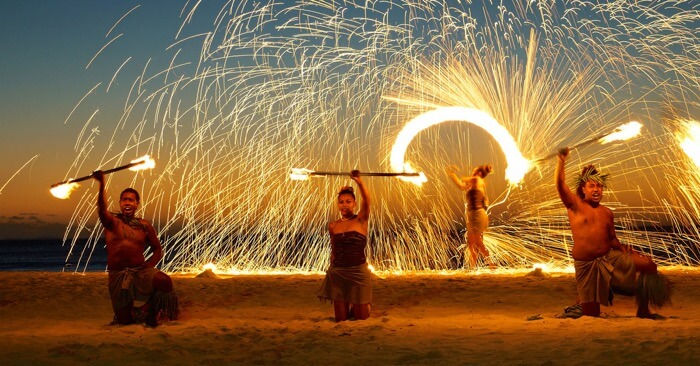
An Island Night in Rarotonga is the cultural experience that travelers talk about long after the tan fades and the suitcase gets unpacked. It is an evening built around Cook Islands traditional dance, feasting, and storytelling. It is all rooted in the living traditions of the people who call this island home. These are not dinner theater productions. They are celebrations of identity, performed by dancers and musicians who carry these stories in their blood.
How the Evening Unfolds
The night often begins with a guided walk through a cultural village, where local artisans demonstrate traditional weaving, carving, and the art of preparing dance costumes. You may witness a traditional welcome ceremony or the lifting of a marae tapu, a sacred ritual that opens the evening with gravity and grace.
Then comes the feast, prepared in the umu, a traditional underground oven where food is slowly cooked over heated stones buried in the earth. The flavors are earthy, smoky, and unlike anything a conventional kitchen can replicate.
As the night deepens, the cultural performance begins. And this is where Rarotonga culture delivers something you simply cannot find anywhere else in the South Pacific.
The Ura Dance and Why Cook Islands Traditional Dance Feels Different from Anywhere Else
At the center of every Island Night is the ura, the traditional dance form of the Cook Islands. The ura dance in the Cook Islands is not simply movement set to music. It is a language. Each gesture, each shift of the hips, each expression on the dancer's face carries specific meaning, narrating legends of ancestral ocean voyages, great battles, love, and the rhythms of the natural world. It is one of the most expressive forms of Polynesian dance in the Pacific. Watching it performed by skilled dancers under a canopy of stars is an experience that leaves even the most seasoned travelers without words.

The drumming that accompanies the ura is equally powerful. The pate, a hollowed wooden drum, drives the rhythm forward. The intensity builds until you can feel the beat resonating in your chest. Fire dancers often close the evening, spinning flames with precision that is both breathtaking and deeply symbolic.
What Makes an Island Night Unforgettable
What truly sets this experience apart is the invitation to participate. Performers regularly pull audience members onto the stage, teaching hip movements and footwork with laughter and genuine encouragement. You will not be graceful. That is entirely the point.
The joy lives in the doing, not doing it perfectly. And in that moment, when you are standing barefoot on a stage with a stranger guiding your hips while drums shake the air around you, the wall between traveler and local dissolves completely.
That shift is everything. It is the difference between watching a culture and being welcomed into one.
Beyond the Big Three: More Ways to Experience Authentic Cook Islands Culture
Sunday church, Saturday market, and Island Night are the three pillars of Rarotonga culture that every visitor should experience. But the island holds layers of cultural richness that go even deeper for those who want to keep exploring.
Walking the Ara Metua and Visiting Ancient Marae
One of the most quietly powerful authentic Cook Islands experiences is walking the Ara Metua. It is an ancient inland road that circles the island and is believed to be over a thousand years old. Along this path, you will encounter marae, sacred meeting grounds that once served as the spiritual, political, and social centers of Polynesian communities.
Standing in these spaces, surrounded by stone and silence and the dense green of the interior, it is possible to feel the weight of centuries of ceremony and gathering still present in the ground beneath your feet.
A Rarotonga cultural tour that includes the Ara Metua and a visit to a marae often features hands-on demonstrations of traditional skills like weaving with pandanus leaves, coconut husking, and taro planting. These tours take you away from the coastal tourist areas and into the heart of communities where heritage is still a daily practice, not a performance.
Tasting Rarotonga: Food as a Window into the Culture

In the Cook Islands, food is never just sustenance. It is an expression of generosity, family, and belonging. Ika mata appears at the market, seaside stalls, and at nearly every communal gathering. Tasting it for the first time, freshly prepared with fish caught that morning, is one of those deceptively simple moments that quietly rewrites your definition of what "fresh" can mean.
The umu feast tradition transforms a meal into a ceremony. And progressive dinner experiences that guide small groups through local family kitchens offer a rare and intimate window into the way food, story, and community intersect across every table on the island.
When to Go to the Cook Islands
Timing matters when you are planning a trip around cultural immersion. The depth of Rarotonga culture rewards travelers who align their visit with the island's most vibrant celebrations.
The best time to visit the Cook Islands for cultural festivals falls during the dry season from June through August. The weather is warm with lower humidity, and the cultural calendar reaches its peak.
The crown jewel is Te Maeva Nui, held every August to mark the anniversary of the Cook Islands' self-governance. This is the nation's largest cultural celebration, drawing performers, families, and communities from all fifteen islands. There are parades, traditional music and dance competitions, handicraft showcases and feasting that pulses with national pride.
The shoulder months of April, May, September, and October offer warm weather with thinner crowds. This is ideal for travelers who prefer a more intimate experience. The Te Mire Ura dance competition runs through the spring months and showcases the nation's finest dancers in fierce, joyful competition. And the annual Pride celebration in April reflects the evolving, inclusive spirit of these islands.
Any time of year will reward you with something meaningful. But if your heart is set on witnessing the full power of Cook Islands dance and celebration at its competitive best, building your trip around these events is well worth the effort.
The Trip You Have Been Searching For

There comes a moment on every trip to the Cook Islands when something clicks. Maybe it happens when the church choir reaches a note so pure that your eyes fill before your mind catches up. Maybe it happens when a woman at the market wraps a handmade pareo around your shoulders and tells you the story behind the dye. Maybe it happens when the fire dancer locks eyes with you and you realize that this ancient story is not being performed in front of you. It is being shared with you.
Rarotonga culture does not shout. It does not sell. It simply opens its arms and waits for you to step in.
I have built trips around these moments for families, for couples rediscovering each other after decades of raising kids, for women traveling solo for the first time in their lives, and for grandparents who want their grandchildren to experience Rarotonga culture firsthand. This is what I do. I take the planning, the logistics, the research, and the worry completely off your plate so that all you have to do is show up and feel every second of it.
If the Cook Islands have been quietly calling you, or if they are calling to you right now for the very first time, I would love to talk about what your trip could look like. Not a template. Not a package pulled off a shelf. A trip designed around you, the people you love most, and the experiences that will stay with you long after you are home.
Let me handle everything. You just exhale.
Oh, and don’t forget to sign up for my newsletter, so you don’t miss the exciting travel information I share.